
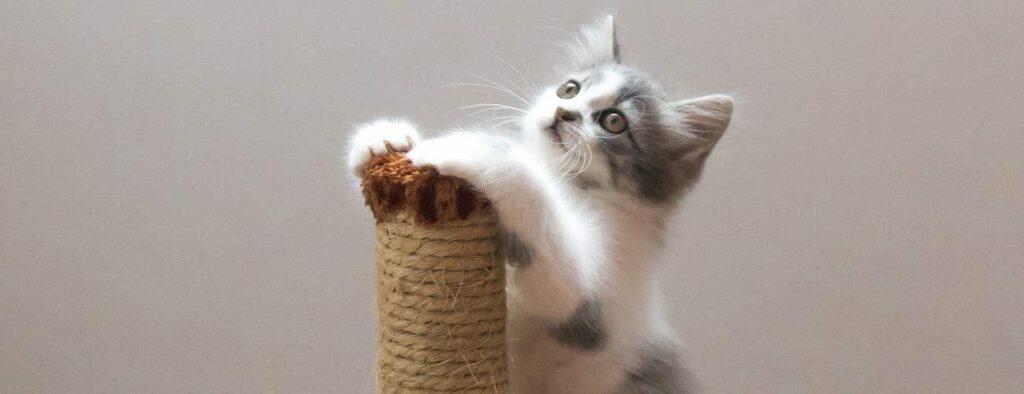
Scratching is one of the most fundamental feline behaviours — cats do it to maintain claw health, stretch their muscles, mark territory, and relieve stress. If you don’t provide an appropriate outlet, your sofa, carpets, and wooden furniture will become those outlets instead. This guide reviews the best cat scratching posts in the UK for 2026, covering tall sisal posts, cardboard scratchers, and wall-mounted options — with specific guidance for large breeds.
Why Your Cat Scratches (and Why It Matters)
Scratching serves four distinct purposes:
- Claw maintenance — removes the dead outer sheath of claws (the “husk”) to expose sharp new claws beneath
- Muscle stretching — the full-body pull action exercises shoulder and back muscles
- Territorial marking — scent glands in the paw pads leave chemical markers; the visual scratch marks are also deliberate signals
- Stress relief — scratching releases tension; stressed or anxious cats scratch more
Understanding this helps you choose the right post: it needs to be tall enough for a full vertical stretch, stable enough to resist vigorous use, and textured in a way that satisfies the claw-stripping function.
Best Cat Scratching Posts UK 2026
1. Kerbl Cat Opal Maxi Scratching Post ⭐ Best Overall UK
Named best overall scratching post in the UK by Catster for 2026, the Kerbl Opal Maxi‘s key differentiator is its glued sisal (not simply wrapped or stapled). This significantly extends the life of the post and prevents the unravelling and fraying that plagues cheaper designs. At 78cm tall, it’s sufficient for most adult cats including medium-large breeds. The base is weighted and wide for excellent stability.
Height: 78cm | Material: Glued sisal | Best for: Most cats | Price: ~£25–£40
2. SmartCat Ultimate Scratching Post ⭐ Best for Large Cats
The SmartCat Ultimate (32 inches / 81cm) is consistently reviewed as the top choice for large breeds including Maine Coons, Ragdolls, and Norwegian Forest Cats. Woven sisal (the textile version of sisal, which is smoother and often more durable than rope), a very heavy base, and verified stability under vigorous 8kg+ cat use make this the UK’s go-to recommendation for larger breeds. Available in neutral colours that complement most home interiors.
Height: 81cm | Material: Woven sisal fabric | Weight capacity: Tested with cats 8kg+ | Price: ~£35–£55
3. Trixie Parla Scratching Post — Best Budget
For small to medium cats or budget-conscious buyers, the Trixie Parla (62cm) offers reliable natural sisal rope construction at a significantly lower price than premium options. The base is somewhat narrower than the SmartCat or Kerbl, which can cause wobble with very active large cats — for smaller cats it performs well. Available in natural brown, cream, and grey.
Height: 62cm | Material: Natural sisal rope | Best for: Small–medium cats | Price: ~£12–£20
4. Sopapets Tall Sisal Scratching Post — Best for Long Cats
At 80cm (31.5 inches), the Sopapets post is specifically designed for long-bodied cats like Turkish Vans and Maine Coons, with sisal rope wrapped tightly on three sides for multi-directional use. The reinforced base has an unusually wide footprint for a budget post, improving stability meaningfully. Well-reviewed for preventing the wobble-induced abandonment that plagues cheaper tall posts.
Height: 80cm | Material: Natural sisal rope (3-sided) | Price: ~£18–£28
5. Wall-Mounted Sisal Panels ⭐ Space-Saving Alternative
For cats who prefer horizontal or angled scratching (often seen in cats that scratch sofas and carpet) or for owners short on floor space, wall-mounted sisal panels are an excellent solution. CanadianCat and Feandrea both offer UK-shipped wall-mount kits in sizes from 30×50cm to full corner pieces. These are particularly effective for cats whose scratching preference has been established on horizontal or low-angle surfaces.
Sisal vs Cardboard vs Carpet: Which is Best?
| Material | Texture | Durability | Cats’ Preference | Notes |
|---|---|---|---|---|
| Sisal rope | Rough, fibrous | ⭐⭐⭐⭐ | 1st choice for most | Most closely matches natural bark texture |
| Sisal fabric/weave | Smooth-rough | ⭐⭐⭐⭐⭐ | Preferred by some | More durable than rope; doesn’t unravel |
| Corrugated cardboard | Layered, quiet | ⭐⭐ | High — especially horizontal | Cheap to replace; horizontal scratchers love it |
| Carpet | Fuzzy | ⭐⭐⭐ | Variable | Can confuse cats between post and carpet floor |
| Wood/bark | Natural rough | ⭐⭐⭐⭐⭐ | Very high | Closest to nature; premium price |
Buying Guide: Scratching Post Height and Stability
Height: Your Cat Must Be Able to Fully Stretch
A scratching post must be tall enough for your cat to perform a complete vertical stretch — front paws at full extension, body elongated. This is the posture cats adopt naturally, and a post that prevents this will be ignored. Minimum height recommendations:
- Average adult cat: minimum 65–70cm
- Large breeds (Maine Coon, Ragdoll, Savannah): minimum 80–90cm
- Kittens: any height over 40cm is fine initially, but they’ll outgrow it quickly
Stability: The Make-or-Break Factor
Cats will try a scratching post once. If it wobbles or tips, they won’t use it again. The base should:
- Weigh at least 3–4kg for a post over 60cm
- Extend at least 30×30cm for a 60cm post (proportionally wider for taller posts)
- Sit flat on both carpet and hard floor without rocking
If your post wobbles, try placing a non-slip mat underneath, or weight the base with a heavy book or sandbag while your cat builds confidence with it.
Placement
Location matters hugely. Cats scratch most in areas where they:
- Wake up and stretch (place near sleeping spots)
- Enter or exit a room (door-adjacent placement)
- Mark territory (multi-cat households should have 1 post per cat plus one extra)
If your cat is already scratching the sofa, place the post directly in front of that spot initially, then gradually move it to a more convenient location over 2–4 weeks.
FAQs
How do I get my cat to use a scratching post?
Place it near where your cat already scratches (usually near sleeping spots or entry points). Rub dried catnip on the base and lower post. Dangle a feather wand near the top to encourage the cat to reach and scratch. Never physically guide the cat’s paws — this is aversive and counterproductive. Most cats adopt a correctly-placed post within 1–2 weeks.
Why does my cat ignore the scratching post and scratch the sofa instead?
Usually one of three reasons: (1) the post is **too short** for a full stretch, (2) the post **wobbles** and the cat has rejected it as unstable, or (3) the post is in the **wrong location** — too far from where the cat naturally marks. Address stability and height first, then relocate closer to the problem area.
How long does a sisal scratching post last?
With a single cat using it daily, a quality sisal post typically lasts 12–24 months before the sisal becomes significantly frayed. Some brands (Armarkat, SmartCat) sell replacement sisal panels, extending the life of the base indefinitely. Cardboard scratchers need replacing every 2–8 weeks depending on intensity of use.
🐾 Recommended Cat Scratching Posts & Trees
We’ve hand-picked these products for you. As an affiliate, we may earn a commission if you purchase through our links, at no extra cost to you.