
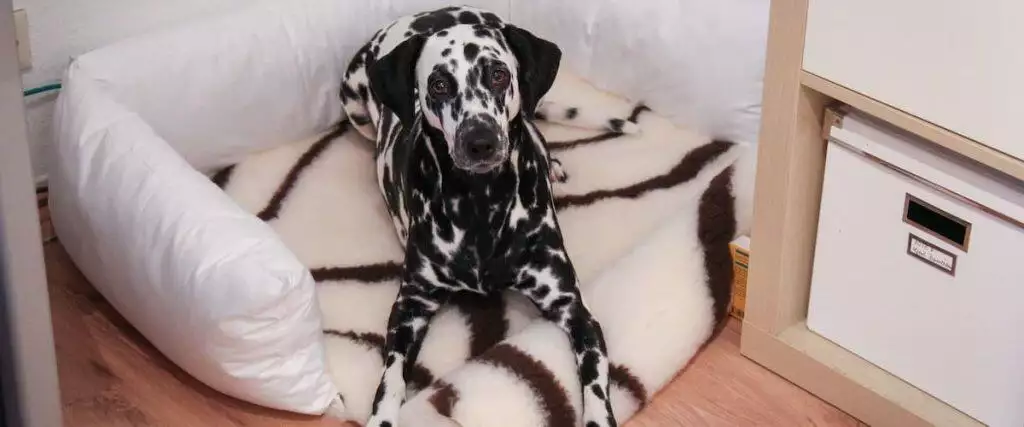
Quick answer: Choose veterinary fleece by backing, drainage setup, finished size and the care label on the exact product. A green-backed fleece is the practical choice when liquid needs to pass through to an absorbent layer below. A rubberised non-slip backing is usually easier to keep in place on a crate tray or hard floor, but it normally has a lower wash-temperature limit. Neither type is waterproof, chew-proof or a substitute for veterinary care.
“Vetbed” is also used in two ways. Vetbed® is Petlife’s registered product range, while many shops use “vet bed” as a generic description for deep-pile veterinary fleece. Check the brand and sewn-in care label instead of assuming that every similarly named product has the same backing, pile or washing instructions.
The brand name and the product category
Petlife states that it is the home of the original Vetbed® brand. Other manufacturers sell their own veterinary fleece, including Vetfleece and ProFleece. Those products can be useful alternatives, but their specifications are not interchangeable.
| Term on a listing | What it may mean | Evidence to look for |
|---|---|---|
| Vetbed® Original | Petlife’s green-backed branded fleece | Petlife/Vetbed branding, exact dimensions and the product care label |
| Vetfleece | A separate Yorkshire-made brand with greenback, heavy-duty and non-slip ranges | Vetfleece label, stated pile/backing and range-specific washing instructions |
| ProFleece | A separate veterinary-fleece range sold by Simply2pets/NoseyPaws | ProFleece branding, backing, GSM or pile information and its care instructions |
| Vet bed / veterinary bedding | A generic category description that may cover many makers | A named manufacturer, material, backing, dimensions and a readable care label |
A marketplace title alone is not enough to prove that a generic fleece is the Petlife product. If the brand matters, use the manufacturer’s identifiers and packaging rather than a seller’s repeated use of the words “vet bed”.
The drainage system beneath the fleece
Drainage fleece does not absorb an unlimited amount of liquid or make the floor waterproof. Its job is to let moisture move away from the pile. The liquid still needs somewhere to go. On a suitable setup, the layers are:
- Top layer: correctly oriented veterinary fleece, pile facing the animal.
- Receiving layer: an absorbent, washable or disposable pad below the fleece.
- Protected base: the whelping-box floor, crate tray or other surface that can be cleaned and dried.
Vetfleece explicitly describes its greenback product as allowing liquid to pass through to an absorbent pad. If fleece is placed directly on an impermeable tray, liquid can remain trapped underneath. Lift the bedding, replace or clean the receiving layer and dry the base rather than judging dryness only by touching the pile.
A rubberised non-slip backing serves a different priority. It can improve grip on smooth surfaces, but may drain differently and can be damaged by temperatures that a green-backed product tolerates. Never transfer a high-temperature claim from one backing to another.
Current Amazon UK examples
Affiliate disclosure: The links in this section are Amazon Associate links. PETZ may earn a commission from qualifying purchases at no extra cost to you. We opened these exact Amazon UK listings and checked the ASIN, title, selected size and UK availability on 25 September 2026. They are current examples for different needs, not hands-on test winners. Seller, stock, grouped variants and delivery can change.
| Current listing | Verified description | Check before ordering |
|---|---|---|
| Petlife Vetbed Original, grey, 40 × 30 in, ASIN B000UGHSLI Check the current listing on Amazon UK → |
The current listing identifies Petlife’s Original Vetbed in grey at 40 × 30 inches. Petlife describes Original as green-backed, quick-drying veterinary bedding and gives separate normal-care and occasional high-temperature instructions. | Confirm that the chosen colour and size still show the Petlife/Vetbed brand. Follow the label for that exact piece; do not apply the Original range’s temperature to a non-slip variant. |
| Vetfleece Non-Slip Multi-Paw, charcoal/pink, 48 × 30 in, ASIN B00WT3B9SI Check the current listing on Amazon UK → |
The selected Amazon variant is 120 × 75 cm with a non-slip backing. Vetfleece describes this range as 25–28 mm pile, 1200 gsm and made in its Yorkshire mill. | Choose it for grip rather than high-temperature washing. Vetfleece says its non-slip fleece should be washed at up to 40°C because higher heat can damage the backing. |
| ProFleece Premium greenback, white, 75 × 75 cm, ASIN B0CNJ4JWPY Check the current listing on Amazon UK → |
The selected listing is a 75 × 75 cm white ProFleece Premium greenback. ProFleece’s UK information describes the standard greenback as 1200 gsm and washable up to 40°C. | White makes soiling easy to see, but the square size may not fit a rectangular crate. Measure first and allow for the manufacturer’s note that some loose fibres can appear when new or at cut edges. |
No fixed price, star score, stock promise or overall “best” ranking is carried into this guide. Reopen the exact listing immediately before payment and make sure Amazon has not switched colour, size or backing within a grouped product family.
Backing choices by job
| Use | Likely starting point | Important limitation |
|---|---|---|
| Whelping box or repeated accidents | Greenback over an absorbent pad | The lower layer and box still need frequent checking and changing |
| Hard floor or smooth crate tray | Non-slip backing | Heat can degrade rubberised backing; obey its lower wash limit |
| Cut-to-fit crate or carrier | Greenback or a maker-approved cut-to-size range | Leave no curled edges, loose strips or accessible fibres |
| Professional or repeated hot-wash use | An exact product specifically labelled for it | High heat can shorten service life and is not a universal vet-fleece feature |
| Dog that chews bedding | Supervised trial only | No textile fleece should be treated as chew-proof |
The familiar green colour is a backing type, not proof of a universal performance standard. Likewise, a paw-print coating may improve grip but does not establish how it drains or how hot it can be washed. Use the sewn-in label as the final authority.
Measuring and cutting without creating traps
Measure the usable base of the crate, pen, carrier or whelping box, not its external dimensions. A piece that rides up the side can fold over a small puppy; a piece that is too short exposes cold or slippery areas. For an adult dog, also check that the finished surface is large enough for natural resting positions. The RSPCA recommends enough room for a dog to curl, stretch and change position.
- Measure the internal length and width at floor level.
- Check whether bowls, rails, doors or corner fittings reduce the flat area.
- Mark the backing and cut only if the manufacturer says that range can be trimmed.
- Remove loose cut fibres and inspect the edge before use.
- Lay the piece completely flat and confirm that a door cannot catch or bunch it.
Vetfleece says its products can be cut to fit and may show slight edge fraying at first; Petlife also notes that initial loose fibres and some shedding at cut edges can occur. Those statements are not permission to ignore loose material. Inspect before every use, especially with puppies or dogs that mouth bedding.
Whelping-box use and newborn safety
Veterinary fleece can be one component of a whelping-box setup, but it does not make the box self-cleaning or safe by itself. The Kennel Club advises changing whelping-box bedding regularly to keep it fresh, clean and hygienic, and checking newborn puppies every couple of hours. Puppies must also be able to move away from an added heat source.
- Use a flat, correctly sized piece that cannot form a pocket underneath the puppies.
- Place a suitable absorbent layer below a drainage fleece and inspect both layers often.
- Keep at least one clean replacement ready so a wet or soiled piece can be changed promptly.
- Remove loose fibres, damaged edges and any part that the mother or puppies are chewing.
- Keep the box temperature and heat-source arrangement under appropriate breeder and veterinary guidance.
A dry-feeling top does not prove that the pad or box below is clean. Lift the fleece during checks. If a puppy is cold, crying, not feeding normally or otherwise concerning, contact a vet promptly rather than relying on bedding changes alone.
Crates, carriers and everyday resting areas
For a crate tray or smooth floor, grip can matter more than maximum drainage. A non-slip backing may reduce movement, but test the complete setup: the fleece should remain flat when the dog turns, digs lightly or enters through the door. Replace it if the coating flakes or separates.
Introduce a crate positively and at the dog’s pace. PDSA describes a crate as a rest space, not a punishment, and recommends soft bedding in a quiet, draught-free location. The dog should still have water, appropriate breaks and another comfortable option where possible.
Veterinary fleece is thinner than a supportive mattress. It may be useful as a washable top layer, but it does not automatically provide the depth or load distribution of a well-constructed orthopaedic dog bed. If the dog’s joints, shoulders or hips press through to a hard base, add an appropriate support layer rather than relying on pile height.
Recovery, wounds and incontinence
A washable surface can simplify housekeeping for an older, recovering or incontinent dog, but “veterinary bedding” is a product category, not a medical prescription. PDSA advises following the individual vet team’s instructions after surgery, providing a warm quiet place to rest and checking wounds for redness, swelling, bleeding or discharge. Do not put creams or cleaning products on a wound unless the vet has told you to.
For incontinence, combine the fleece with a genuinely absorbent lower layer, change wet components promptly and keep the dog’s skin clean and dry. If leakage is new, worsening or accompanied by discomfort, ask a vet. Bedding manages the environment; it does not diagnose or treat the cause.
Dogs with limited mobility may also need a low entry, adequate mattress support and secure flooring around the bed. A non-slip back under the fleece does not prevent the dog slipping on the approach. Our waterproof dog-bed guide explains the difference between a drainage layer, an absorbent layer and a waterproof barrier.
Washing by label rather than category
There is no single safe wash temperature for everything marketed as vet bedding. The manufacturers checked for this guide publish different limits:
- Petlife Vetbed Original: Petlife gives 40°C for normal use and up to 95°C for occasional disinfection; it says not to tumble dry and to use non-biological detergent.
- Petlife Non Slip: Petlife states a maximum of 65°C for this different backing.
- Vetfleece greenback: the maker recommends 40°C for routine washing and warns that repeated higher temperatures shorten service life.
- Vetfleece non-slip: up to 40°C; the maker says hotter washing can cause the backing to deteriorate.
- ProFleece greenback: up to 40°C, with air drying or a cool tumble setting.
Before washing, shake or brush off hair and grit, then use a laundry bag if the maker recommends one. Wash the absorbent pad separately when its instructions differ. Dry every layer completely before rebuilding the setup. Avoid fabric softener, bleach or a hot dryer unless the exact label explicitly allows it; residues and excess heat can affect fibres or backing.
Two correctly sized pieces are often more useful than one expensive piece: one can be in use while the other is washed and fully dried. That rotation only works if the receiving pad and hard base are cleaned too.
Damage, chewing and replacement signs
Deep pile is not indestructible. Stop using the fleece if the backing splits, the rubber coating flakes, a hole exposes long strands, an edge repeatedly curls or material appears to be missing. Puppies and determined chewers should be supervised during introduction.
Do not rely on listing phrases such as “anti-chew”, “chew resistant” or “impossible to chew” as a safety guarantee. If fabric may have been swallowed, contact a vet for advice. For dogs that damage soft bedding, see our chew-resistant dog-bed guide, which explains why no textile bed should be called indestructible.
Replace a piece when it no longer lies flat, no longer survives cleaning intact or cannot be made dry and odour-free. A clean-looking pile does not compensate for a failing backing.
A practical buying checklist
- Decide whether drainage or floor grip is the main requirement.
- Identify the actual manufacturer and range, not just the words “vet bed”.
- Measure the internal base and the dog’s resting positions.
- Plan the layer below a greenback fleece.
- Read the exact wash and drying label before buying.
- Check whether the selected product may be cut and how its edges behave.
- Avoid loose folds, accessible strips and unsupported medical claims.
- Recheck the exact Amazon variant, seller and availability before payment.
Method and review scope
This is a desk-researched selection and care guide, not a hands-on product test, veterinary endorsement or hygiene guarantee. On 25 September 2026 we opened the exact Amazon UK pages and ASINs listed above using a UK delivery location. We cross-checked range, backing and care information against current pages from Petlife, Vetfleece and ProFleece/Simply2pets, and used current Kennel Club, RSPCA and PDSA welfare guidance.
The previous PETZ page treated different brands and backings as if they shared one wash regime and carried unsupported claims about chewing, bacteria and medical use. Its old ACF product cards and FAQ are not publicly rendered and were not used as evidence. This replacement separates branded Vetbed® from generic veterinary fleece and makes the complete drainage setup visible.
Sources and related PETZ guides
- Petlife: Genuine Vetbed ranges
- Petlife: Vetbed Original specifications and washing instructions
- Vetfleece: washing, cutting and product-identification FAQ
- Vetfleece: Original Greenback construction and drainage setup
- ProFleece: range and care information
- The Kennel Club: rearing puppies and changing whelping-box bedding
- RSPCA: dog-bed size, washing and placement
- PDSA: caring for a dog after surgery
- PETZ: dog-bed types and selection guide
- PETZ: whelping-box guide