
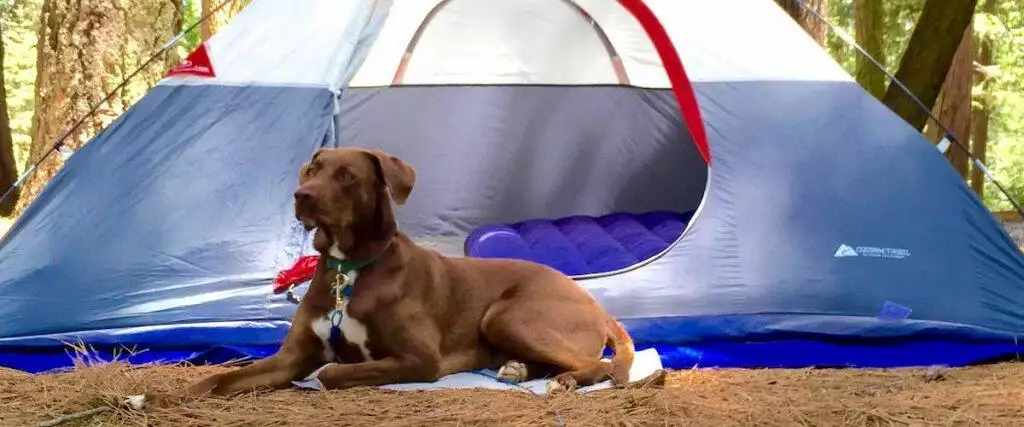
Quick answer: choose a travel bed for the journey you will actually make. A backpacking mat needs a measured packed size and weight; a car-camping bed can trade more bulk for cushioning; a bed used on damp ground needs a protected underside and a dry place inside the shelter. “Camping”, “outdoor” and “waterproof” do not prove any of those things on their own.
Blue Cross recommends taking a familiar bed and blankets because they can help a dog settle at a campsite. Familiarity matters, but so do usable sleeping space, a surface that stays dry, simple cleaning and a safe temperature. This guide shows how to check those features without inventing a universal winner.
Start with the journey, not the product label
| Trip | Prioritise | Common mistake |
|---|---|---|
| Backpacking or a walking holiday | Published bed weight, packed dimensions, carry method and enough open space for the dog’s normal sleeping position | Calling a bed “packable” without checking whether it fits the actual rucksack |
| Car camping or caravan travel | More cushioning, stable base, washable construction and dimensions that fit both the dog and storage space | Buying by breed label rather than measuring the usable sleeping area |
| Tent on damp ground | Dry pitch, intact tent groundsheet, protected bed underside and a way to dry wet layers | Expecting a water-resistant mat to compensate for a leaking or badly pitched shelter |
| Hotel, cottage or family visit | Clean underside, familiar scent, quiet placement and low bulk | Assuming the accommodation permits a wet or muddy bed indoors |
| Older or less mobile dog | Low access, stable grip, sufficient cushioning and short, manageable travel stages | Treating the words “orthopaedic” or “supportive” as proof of a medical benefit |
Measure the dog while stretched in a typical sleeping position, then compare that measurement with the open, usable area. Also measure the packed bed and weigh it if the manufacturer does not publish a credible figure. A stuff sack does not automatically make a bed suitable for carrying all day.
Current Amazon UK examples
Affiliate disclosure: The links in this section are Amazon Associate links. PETZ may earn a commission from qualifying purchases at no extra cost to you. These exact Amazon UK listings were checked on 22 September 2026. They illustrate three portable constructions and are not hands-on test winners. Prices, stock, sellers, colours and variants can change.
| Current listing | Verified description | Check before ordering |
|---|---|---|
| Chuckit! Travel Bed, ASIN B00027466A Check the current listing on Amazon UK → |
Petmate specifies a 39 × 30 × 3-inch bed with a stuff sack, machine-washable construction and a water-resistant finish. | It is one size and water-resistant, not a verified waterproof barrier. Check that the sleeping area suits the dog and that the packed bundle suits the journey. |
| OneTigris portable sleeping mat, ASIN B07ZH4886L Check the current listing on Amazon UK → |
The current Amazon listing is a portable Oxford-fabric travel mat. OneTigris describes its outer and lining as water-, grease- and scratch-resistant, with polyester filling and a carry strap. | Confirm the selected size: Amazon’s current title is for the medium variant. “Scratch-resistant” is not chew-proof, and water resistance is not proof against pooled water or leaking seams. |
| Pet Wiz water-resistant travel mat, ASIN B0FND8THK9 Check the current listing on Amazon UK → |
The maker specifies a 110 × 68 cm double-sided mat in 420D Oxford fabric that rolls into an included carry case. | The maker calls it water-resistant. Check the current care label, open dimensions and whether the 110 × 68 cm surface gives the dog room to change position. |
No fixed price, customer-star score, stock promise or “best” ranking is carried into this guide. The product names, ASINs and relevant maker descriptions were checked separately; an active Amazon page does not prove that every grouped colour or size has identical materials.
Water-resistant is not a substitute for a dry shelter
A travel mat may repel brief contact with damp grass or muddy paws while still allowing water through seams, stitching or prolonged pressure. Check whether the maker describes the top, bottom or complete finished bed. If the wording is only “water-resistant”, plan for splashes rather than pooled water.
- Protect from below: place the bed inside a sound shelter on an intact groundsheet, not directly on saturated ground.
- Keep a dry layer available: carry a separate blanket or cover in a sealed bag so a wet outer surface is not the dog’s only resting place.
- Dry before repacking: trapped moisture can leave the filling cold, uncomfortable and difficult to clean.
- Inspect seams and coatings: abrasion, punctures and repeated folding can create leak paths even when the face fabric still looks sound.
For repeated urine leakage or large spills, a protected inner core is a different requirement from an outdoor mat. See our waterproof dog-bed guide for the distinction between outer fabric, liquid barrier and finished-bed seams.
Warmth and heat need individual judgement
There is no single safe camping temperature for every dog. Coat, body size, age, health, wind, damp, activity and acclimatisation all change risk. The old page’s breed rules and fixed 10°C trigger were therefore not retained. Check the forecast and the dog in front of you; a bed label cannot make unsuitable weather safe.
A thin mat can reduce contact with a hard surface but should not be presented as measured insulation unless the maker supplies a relevant test. In cool or damp conditions, keep the dog dry, provide appropriate bedding and change the plan if the dog cannot settle or stay comfortable. For an older dog or one with a health condition, discuss an active trip with the dog’s vet before booking.
Heat is also a camping risk. Blue Cross warns that a tent can heat quickly like a greenhouse and says never to leave a dog alone in a hot tent. Provide shade, ventilation and fresh water, avoid the hottest part of the day and know the signs of heatstroke. A raised or “cooling” bed is only an optional comfort surface; it does not make a hot tent safe. Our cooling dog-bed guide explains that limit in more detail.
Fit, access and stability
- Usable area: borders, seams and bolsters can reduce the space shown by outside dimensions. The dog should be able to turn and lie naturally.
- Entry: thick rolls, deep filling or a slippery tent floor may be difficult for a stiff or less mobile dog.
- Bottoming out: press the bed where the dog’s shoulders and hips will rest. Soft loft alone does not show whether the ground can be felt through it.
- Movement: test the complete setup at home. A light mat may slide, bunch or lift when a dog circles before lying down.
- Chewing and digging: travel fabric is not indestructible. Stop using a damaged bed if filling, threads, zips or coatings can be swallowed.
Our large dog-bed sizing guide covers usable dimensions, while the orthopaedic dog-bed guide explains access and support checks without treating a marketing term as a clinical guarantee.
Test the whole setup before the trip
- Open the bed at home in the tent, crate or room where it will be used. Let the dog investigate voluntarily and reward calm behaviour.
- Check whether the dog can stretch, turn, rise and leave without the mat sliding or blocking an exit.
- Practise packing and unpacking it. Record the real packed dimensions if they differ from the listing.
- Follow the maker’s washing instructions, then confirm that the bed dries fully and retains its shape before relying on it away from home.
- Pack a towel, repair or replacement plan, and a separate dry familiar-smelling layer.
Blue Cross advises introducing the tent before the holiday and taking a familiar bed and blankets. The RSPCA similarly recommends keeping as much of the dog’s routine as possible and providing a quiet, comfortable, draught-free place to rest. The useful test is not whether a bed looks adventurous in a product photograph, but whether the dog already chooses and uses the complete setup calmly.
Camping safety beyond the bed
- Confirm the campsite’s dog policy, facilities and local veterinary contact before travelling.
- Carry water, bowls, usual food and medication; update the dog’s microchip and ID-tag details.
- Keep the dog controlled around other campers, wildlife and livestock. The Countryside Code says dogs must be on a lead around livestock on open-access land and may be subject to other local or seasonal restrictions.
- Keep away from fires and hot ground, check daily for ticks and bring an appropriate first-aid kit.
- Do not leave a dog alone in a tent or vehicle where heat, escape, distress or changing weather could create danger.
Method and review scope
This is a desk-researched selection and safety guide, not a hands-on product test, veterinary review or temperature guarantee. On 22 September 2026 we checked the exact Amazon UK pages and ASINs shown above, compared relevant manufacturer descriptions, and reviewed current Blue Cross, RSPCA and GOV.UK guidance. We also audited the previous PETZ article for invented star ratings, winners, pack-size and waterproofing claims, fixed temperature rules and unsupported medical implications. Those claims were not retained.
The central distinction is between open comfort, packed burden and moisture protection. A product can perform well on one axis and poorly on another, which is why a single “best camping bed” label is less useful than measuring the actual trip.
Sources and related PETZ guides
- Blue Cross: Camping with dogs
- RSPCA: Taking your pet on holiday
- GOV.UK: The Countryside Code
- Petmate: Chuckit! Travel Pillow Bed
- OneTigris: Dog Sleeping Mat
- Pet Wiz: Water-Resistant Travel Mat
- PETZ: Dog-bed types, fit and buying guide
- PETZ: Waterproof dog-bed construction guide
- PETZ: Chew-resistant bed safety guide